


For most people, AI still lives on a screen.
It writes emails. Summarizes meetings. Analyzes documents. Answers questions in seconds.
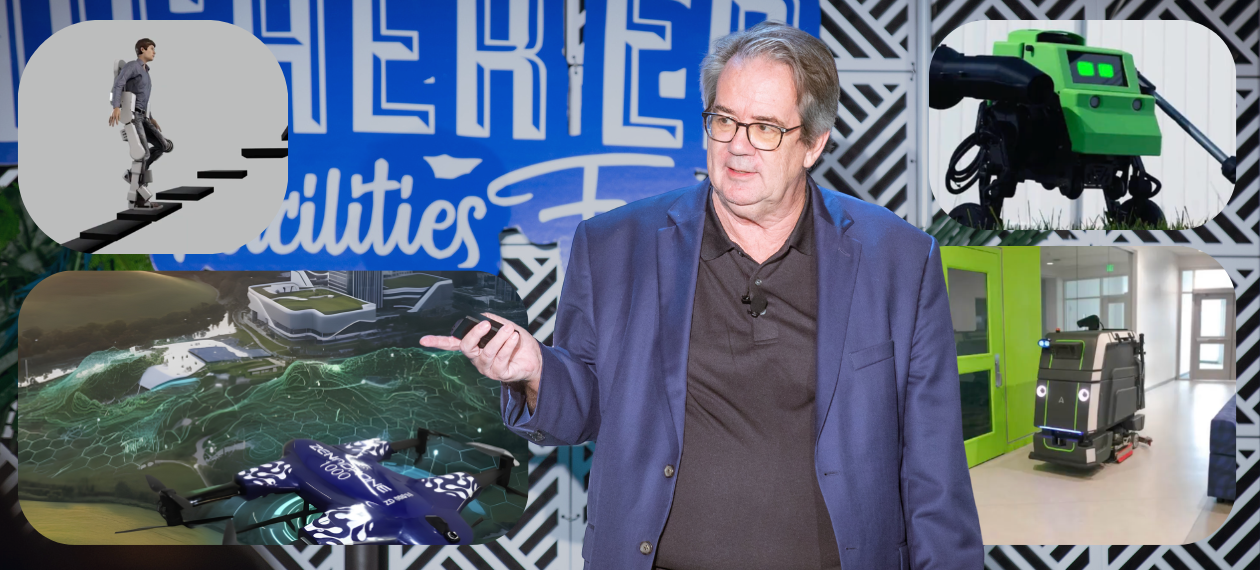
At the K-12 Facilities Forum, futurist Ron Galloway explored what happens when AI moves into the physical world.
As he asked attendees, "What happens when AI makes itself manifest and tangible inside of robots?"
The rest of the talk explored exactly that. From HVAC systems and custodial work to campus security and grounds maintenance, he argued that AI is making robotics dramatically more capable and changing what's possible for facilities operations.
What Could That Look Like on a School Campus?
Galloway walked through several examples of how AI-powered robotics could eventually support facilities teams.
HVAC Systems That Monitor Themselves
One of the most practical examples involved small, snake-like robots designed to move through ductwork and other difficult-to-access spaces.
Galloway described how these systems could inspect HVAC infrastructure, measure air quality, identify blockages, and detect maintenance issues before they become larger problems. He noted that hospitals are already using early versions of this technology to examine HVAC systems, suggesting similar applications could eventually extend to large school campuses.
Cleaning That Becomes Increasingly Autonomous
Most people have already walked past autonomous floor-cleaning machines without giving them much thought.
In fact, Galloway asked attendees how many had seen them at Walmart before pointing out that most people "don't even pay them any mind" anymore because they've become part of everyday life. His point was that robotics on school campuses could follow a similar path as costs decline and capabilities improve.
He also highlighted swarm cleaning systems and walking cleaning robots as technologies already moving in that direction.
Campus Security Around the Clock
He also explored autonomous inspection.
Galloway described drones capable of flying predetermined routes across a campus, identifying broken windows, structural issues, or unusual activity before sending alerts in real time.
He also pointed to ground-based patrol robots already operating in commercial and healthcare environments, predicting that similar systems could become increasingly common on school campuses over the next several years.
Grounds Maintenance Already Taking Shape
Not every example required looking years into the future.
Autonomous lawn mowers already exist and operate much like robotic vacuums, maintaining outdoor spaces without continuous human operation.
For Galloway, grounds maintenance represents one of the earliest examples of robotics quietly becoming part of everyday facilities operations.
Supporting People, Not Replacing Them
Galloway also highlighted assistive robotics, including wearable systems designed to help people lift heavy objects, reach difficult areas, and reduce physical strain during repetitive work.
He pointed to examples already being used in retail and suggested similar technologies could eventually support custodial and maintenance teams while also improving accessibility for students with physical disabilities.
The Bigger Shift Is AI
None of those examples were really the point.
The robots were simply examples of where AI may be headed next.
Throughout the talk, Galloway described robotics as "AI made manifest." Until recently, robots largely performed repetitive, pre-programmed tasks. As AI becomes embedded in physical machines, he argued, those same systems gain the ability to recognize situations, adapt, and perform increasingly complex work.
That was the thread connecting every example, whether the discussion centered on HVAC inspections, custodial work, campus security, or grounds maintenance.
Looking Ahead
Galloway pointed to the rapid adoption of ChatGPT as an example of how quickly new technology can become part of everyday life, suggesting robotics could follow a similar trajectory. His prediction was that within just a few years, seeing robots operating on campuses may no longer feel unusual.
Whether that timeline unfolds exactly as he predicts remains to be seen. His larger point was that AI isn't stopping with software.
As he reminded attendees, "Things are going to come on a lot faster than we thought."
Posted by
Join us at the K12 Facilities Forum!
The community for district and facilities leaders
Nov 8-10, 2026 | San Antonio, TX

-Apr-28-2026-12-38-44-3682-PM.png)
-Apr-28-2026-12-18-09-2338-PM.png)
.png)



Comments